
By Bob Deane, IRS Construction. November 2026
The government’s new remediation Bill passed its second reading on 27 October 2026. Bob Deane of IRS Construction sets out what it changes, where the numbers stand, and what it means for the people responsible for these buildings.
I’ve spent most of my career in external wall insulation, much of it on the systems side, designing and specifying what goes on the outside of buildings. In the past few weeks, the rules on fixing unsafe cladding in England have moved further than at any point since the Building Safety Act 2022. Here’s where things stand, based on what the government and the regulator have published.
1. Where remediation stands
The latest government figures, published on 28 October, show progress to 30 September 2026. Across its five remediation programmes, the government is tracking 4,732 residential buildings of 11 metres and over in England with unsafe cladding. Works have started or finished on 2,621 of them (55%), and 1,878 (40%) are complete. That leaves 2,111 buildings (45%) where work has yet to start.
Completion figures include buildings where remediation work is complete but building-control sign-off is still awaited
Those 4,732 buildings are an estimated 65% to 81% of all buildings of 11 metres and over expected to be fixed through the government’s programmes. A further 1,100 to 2,600 are expected to join, but have yet to be confirmed as eligible.
Medium-rise blocks are further behind. 47% of tracked buildings between 11 and 18 metres have started or finished works, compared with 63% of those over 18 metres.
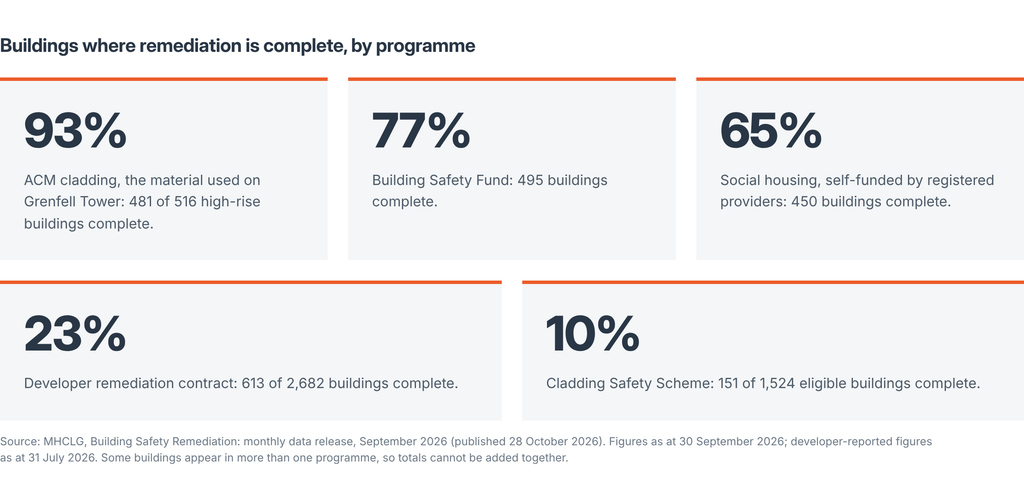
Progress varies widely between programmes. Some buildings sit in more than one, so the totals can’t be added together.
| Programme | Buildings complete |
|---|---|
| ACM cladding (the material used on Grenfell Tower) | 93% of 516 high-rise buildings |
| Building Safety Fund | 77% |
| Social housing, self-funded | 65% |
| Developer remediation contract | 613 of 2,682 (23%) |
| Cladding Safety Scheme | 151 of 1,524 (10%) |
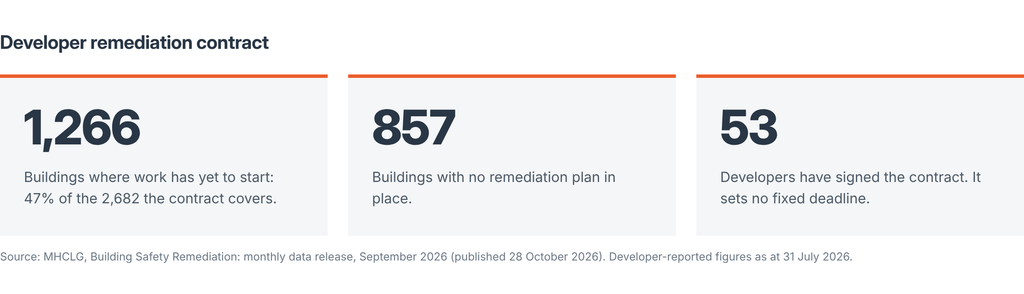
The developer remediation contract stands out. Signed by 53 developers, it commits them to fix or fund life-critical fire safety defects in buildings of 11 metres and over that they developed or refurbished between 1992 and 2022. Work has yet to start on 1,266 of the 2,682 buildings it covers (47%), and 857 have no remediation plan in place. The contract requires repairs “as soon as reasonably practicable”, but sets no fixed deadline. (Developer-reported figures are as at 31 July 2026.)
In the Cladding Safety Scheme, which covers private and social housing, works have started or finished on 452 eligible buildings. Most are still in the programme, and another 2,859 buildings are at earlier stages. Local authorities are also taking enforcement action against 942 buildings.
ACM shows that focused effort works. The task now is to bring the same pace to the thousands of buildings, many of them medium-rise, where work has barely begun.
The new Bill
The Building Safety (Remediation of Unsafe Cladding etc) Bill was introduced to Parliament on 14 October and passed its second reading on 27 October. It now goes to committee for line-by-line scrutiny. The Bill is not yet law, and its provisions may change as it progresses through Parliament.
A legal duty to fix. The Bill puts a duty on the “responsible entity” to identify, assess and remediate life-critical external wall fire safety risks. That’s whoever holds the repairing obligation: a freeholder, a leaseholder with repairing duties, a right to manage company or a resident management company. It covers multi-occupied residential buildings in England over 11 metres or with at least five storeys, completed before 28 June 2022, in both the private and social sectors.
One standard for assessments. Fire Risk Appraisals of External Walls (FRAEWs) must follow the PAS 9980 methodology, which will be set out in regulations. Homes England will audit every FRAEW that recommends mitigation or remediation, and a proportion of those that don’t.
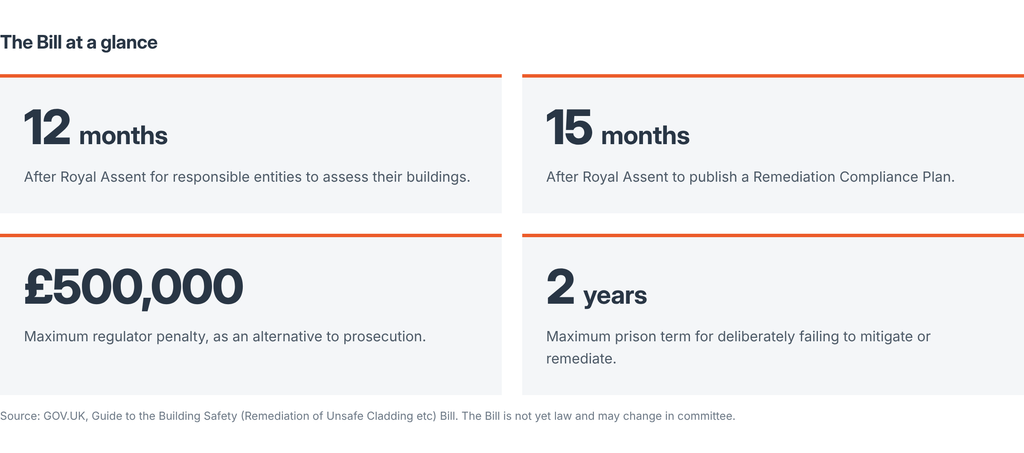
Deadlines tied to Royal Assent. Responsible entities will have until 12 months after Royal Assent to assess their buildings, and until 15 months after to publish a Remediation Compliance Plan.
Penalties. Deliberately failing to mitigate or remediate as soon as reasonably practicable can lead to prosecution and up to two years in prison. As an alternative, the regulator can impose a financial penalty of up to £500,000. Directors can be prosecuted where a company’s failure comes from their consent, connivance or neglect. Obstructing assessment or remediation work carries a fine of up to £40,000 for individuals, and a penalty based on worldwide revenue for companies.
A backstop. Where a responsible entity won’t act, local authorities or Homes England can apply to the First-tier Tribunal for a Remediation Management Order, then carry out the works and recover the costs.
The Bill sits alongside the target in the government’s December 2024 Remediation Acceleration Plan. By the end of 2029, the government’s target is for every building over 11 metres with unsafe cladding to be remediated or to have a date for completion. Landlords that do not meet the target will be liable for severe penalties.”
Leaseholders and manufacturers
At second reading, the government announced further protection for leaseholders who had fallen through gaps in the Building Safety Act:
- New funding for internal high-risk fire safety work in collectively owned and enfranchised buildings, which have no separate freeholder
- The limit for owners of more than one flat, for protection from non-cladding defect costs, rises from three properties to six
- Work to close the gap for leaseholders who bought a flat as their only home but lost protection because of a previous owner’s status
Building Safety Minister Baroness Blake said: “We are going further to protect more homeowners from unfair costs.”
The government also plans to make construction product manufacturers contribute to the cost of remediation. The Bill changes section 149 of the Building Safety Act so that a product only needs to have made “more than a trivial contribution” to a building being unsafe. Developers and others who have paid for remediation will be able to claim directly against manufacturers. These changes apply across the UK.
A register for medium-rise buildings
High-rise buildings are already registered with the Building Safety Regulator. The Bill adds a register for residential buildings in England with two or more homes that are 11 to 18 metres tall, or have five or six storeys.
The requirements start once secondary legislation is laid, expected eight to ten months after Royal Assent. There will be an upfront fee, expected to be similar to or lower than the £251 charge for higher-risk buildings. Failing to register or keep information up to date can bring penalties of up to £7,000, rising to £40,000 or prosecution if it continues.
Given where the figures are, this matters. Medium-rise blocks are the group furthest behind, and the register should give a much clearer picture of how many there are.
The regulator
Gateway 2 applies to new higher-risk buildings and to work on existing ones, including remediation. The Building Safety Regulator’s latest figures cover the 12 weeks to 5 October 2026.
- Gateway 2 approvals overall reached 87%, with 330 of 378 decisions approved
- New higher-risk buildings: 96% approved, with a median of 23 weeks
- Remediation of existing buildings: 87% approved (96 of 110 decisions), covering 8,649 homes
- Remediation applications made in 2026 are taking around 22 weeks. Older, more complex cases from 2024 had a median of 32 weeks
- Gateway 3: nine decisions, all approved, with a median of 20 weeks
That’s real progress on approvals. The regulator is also turning its attention to what happens after them. At a press briefing in July, BSR chair Andy Roe said the regulator would look more closely at how main contractors oversee their supply chains as projects move from Gateway 2 to Gateway 3.
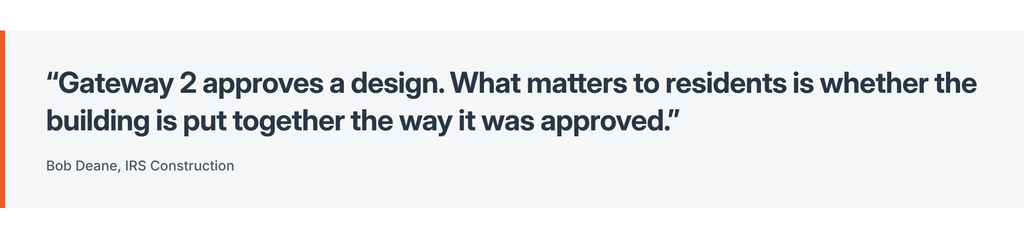
I think that’s the right place to look. Gateway 2 approves a design. What matters to residents is whether the building is put together the way it was approved.
What this means for building owners
The Bill isn’t law yet, and the detail may change in committee. But the direction is clear, and the deadlines will run from Royal Assent. My advice to freeholders, housing providers and managing agents is to start now:
- Know your buildings. If you have blocks of 11 metres or more without a Fire Risk Appraisal of External Walls (FRAEW) to PAS 9980, consider commissioning one now. The Bill proposes a 12-month assessment period from Royal Assent, and assessors may be in high demand.
- Don’t forget medium-rise. Blocks between 11 and 18 metres are furthest behind, and the register will bring them into much sharper focus.
- Choose a contractor who can show the work. Approval is only the start. You’ll want a clear record of what was specified, what was ordered and what was installed, so the Golden Thread holds up at completion.
At IRS Construction, we source our own materials and labour so we stay in control of time, cost and quality on every job. We’ve also been building new systems to tie every order on site back to the approved design. More on that soon.
If you’re weighing up options on a building, we’re always happy to talk.
Sources
- Building Safety Remediation: monthly data release, September 2026 (MHCLG, 28 October 2026)
- Guide to the Building Safety (Remediation of Unsafe Cladding etc) Bill (GOV.UK)
- More people protected as government acts to make more homes safe (GOV.UK, 27 October 2026)
- Remediation Acceleration Plan (GOV.UK, 2 December 2024)
- Building control approval application data (Building Safety Regulator)
- Stricter subcontractor quality control to be enforced by the Building Safety Regulator (ECA, July 2026)
- Government introduces Remediation of Unsafe Cladding Bill (Hamlins, 28 October 2026)
- Almost half of buildings under developer contract still await repairs (Construction News, 29 October 2026)